
Churchgoing
'I am the Resurrection and the Life./Strong deep and painful, Doubt inserts the knife' (Betjeman)

I am sitting in Rittenhouse Square
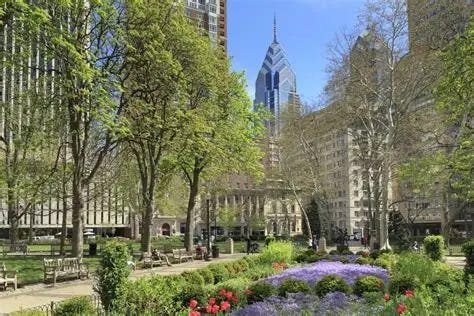
in the sunshine. In Emily’s early days in Philly, she lived here and it was our stamping ground before she moved to West Philly. We’ve had some really happy times here, but also some very sad ones, so it slightly churns me up every time I revisit. I still love wandering about here, though. I am sitting in a cafe, drinking coffee and reading Aylmer Maude’s Life of Tolstoy.It is even better than I remembered, and I’d like to write about it here quite soon. Meanwhile, the sun is shining, and I read - ‘Regarding a future life, Tolstoy’s views changed after he began to wriute of these things in the early eighties. At first he saw no reason for believing in life after death.’… Later, ‘ the consciousness that his most real Self was part and parcel of the Infinite grew so strong within him, that it appeared inconceivable that it should cease at the death of his body’. I put down my book, sip some coffee and listen to the nearby bells of St Mark’s ringing in Locust Street
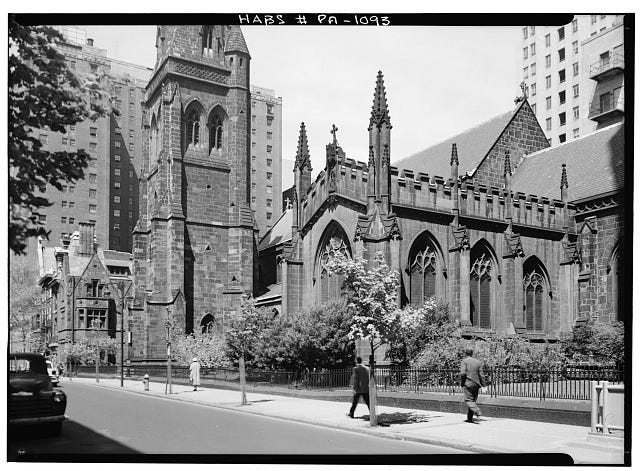
I nearly always go to church when I am abroad, and in America, the religion I like best - High Church Anglicanism - seems to be alive and kicking. Unlike the High Church in England, where the ordination of women created a savage , often hate-filled, division between the Big Enders and the Little-Enders, the Anglo-Catholics of America appear to have noticed that, after the arrival of women priests, the skies have not fallen. As a pillar of the Church of the Advent, in Boston, said to me years ago when women first joined the ranks of the clergy, and some men were wondering if there even could, let alone should, be female clergy - ‘The God who can turn water into wine can surely turn a woman into a priest’.
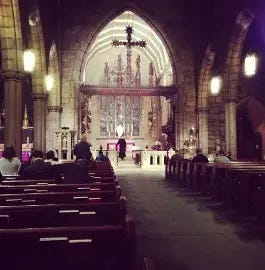
In Philly, I like to go to St Mary’s, on the edge of the campus of U Penn, where my daughter Emily is a professor of Greek. Emily is not a churchgoer, but we all have a happy family relationship with this church - Emily’s children having been to the creche which meets in the crypt. The priest, also called Emily, is wonderful, and the church is the old Prayer Book, which , to an English visitor is a rare treat. But this Sunday, I go to St Mark’s, Locust Street ,because I am meeting my daughter for lunch near Rittenhouse Square. When you walk into this darkened, beautiful Victorian interior place, you are stepping back to the true glory days of Anglo-Catholicism. A magnificent choir gives a concert-level performance of a Palestrina Mass. Acolytes drift to and fro in clouds of incense. The place is packed out. And the sermon is by Mother Lucy Ann Dure. The name itself is a sort of poem, no? It is a well-constructed, beautifully-delivered oration, and it is the most fervent, unambiguous call to us all to believe, without doubt or qualification in Life After Death.
I love the Christian Church in all its forms, while believing less and less as I grow older. I try to conform to the Everlasting Gospel. I feel ever-deepening gratitude to the three-thousand years or so of tradition, including the wisdom of Judaism and of Plato’s Academy, in such places as St Mark’s Locust Street. It is not just an ‘aesthetic’ appreciation of bells and smells, and beautiful music. It is a sense that these places do not merely cherish but they embody a way of life which helps us all to be kinder people, less materialistic, less angry, less self-centred. Such churches have always been engaged with the poorest of the poor, with the sick and the lonely and the bewildered. But the bewilderment is not something which will go away, and whenever I feel swept up in the drama of Christian life and tradition, I also find it impossible to banish Doubt. When I was a child and a young man I thought I would become a priest, but when it actually came to the moment of offering myself for ordination, I thought of the most serious aspect of a priest’s life - namely anointing and befriending the dying, and sitting with them in their last hour. When they asked for reassurance, when they spoke to me of their hope of Heaven, would I be lying when I told them that I had absolute confidence in Life Beyond?
Funnily enough I have had three very distinct experiences of the ‘paranormal’ in my grown-up life, which have made me feel that three different people have been in some way or another ‘in touch’. But even though I have definitely ‘believed’ in these experiences (too intimate to describe here), this does not stop me doubting; in fact I question the very nature of these ‘experiences’, and wonder whether it is not simply that I missed these dead ones so much that my heart had conjured them up out of desire .
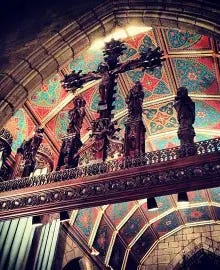
The preacher at mass, Mother Lucy Ann Dure, was magnificent. The mass was a glory. St Mark’s, Locust Street is a real gateway into the Heaven of Heavens. And yet, and yet, and yet. In the sunshine of Rittenhouse Square, I walked around, trying to hold on to the knowledge of all that I had learnt from the last hour, and not to dwell on the Doubt which nags at the heart of the experience. I sat down and began to write this poem -
ON HEARING A SERMON BY MOTHER LUCY ANN DURE AT ST MARK’S LOCUST STREET
In the bright vision of a Philadelphia spring,
In that glad glory, I hear the choir of St Mark’s Locust Street sing
Palestrina, and in candle-lit chancel , perfectly choreographed, I watched
Acolytes and brocaded priests mysteriously waft
Like shafts of sun in incense smoke, which gleam
Through long decades of worship and of dream.
So many years of my life, watching loves, marriages, creeds collapsing,
So many years of praying, affirming, lapsing;
And now, here in the pulpit, surpliced Mother Lucy in a golden stole
Speaks of the Immortality of Soul.
Speaks of the Resurrection of the Dead;
And I am held by every word that’s said.
Lucy Ann in the Victorian pulpit. Blessed are the poor
In spirit. Blessed is the Faith of Lucy Dure,
Et expecto - blessed are the Dure in Heart -
For they shall see God - Our Mother who art
And wilt in Heaven be - she spoke of the songs her childhood used to know -
Each summer with her folks, Sweet Chariot, swing low -
She spoke of a simple, grounded faith - my loss
Of faith gnawed - One more river to cross -
Her voice, as clear and bell-like as her faith,
Spoke to my heart. Now and in the hour of my death,
Pray for me, Mother Lucy Ann Dure,
That I might have a quiet faith, which will not flicker but endure.
Blessed are those who have not seen, and yet
Can kneel with Doubting Thomas at the wounded Feet.
Believe, believe, the Risen Lord says, TRUST.
This thing is actual. It is the Thing-in-Itself, you must
See this is REAL. From His arising, we infer
OUR Immortality. A Truth. A something sure.
*
To be a mad priest , or a lightning rod
Between us, suffering mortals, and our God:
That was my youthful hope, and I’d have done
It all, the bizarre golden glad-rags, the hateful institutional church, but for one
Thing, one only. When, gasping on their bed
& knowing that they’d very soon be dead,
They’d look at me, the sufferers, with eyes
That needed more than empty pieties.
They’d need to know
That when their corpse, morgue-bound, was wheeled from ward
They’d be with angels, gazing on Our Lord.
Sometimes, I’d think, ‘maybe the WORDS suffice.
I’d hold their hands and pray the word’s. ANIMA CHRISTI, call on Christ’.
And then I’d think, ‘but this isn’t enough, merely to SEEM
To share in Dante’s or in Elgar’s DREAM’.
‘But, father, is it true, I’ll meet my wife,
Whose agonizing death destroyed my life?’
‘My cancer-eaten child, will I again,
Gaze on her face, eyes, limbs and spirit, now free of pain?’
‘My motor-bike-mashed lover, does he yet love
My broken heart? He waits for me above?’
They’d plead these questions to my tearful eye,
And there they’d read, quite unmistakably, a lie.
They’d know my prayers had fallen from dishonest lips,
That when you’re dead, you’re dead, you’ve had your chips;
That to an honest mind, religion fails
By offering to console with fairy tales;
Insults the grieving, mocks their true heartbreak
With something ultimately cruel, so obviously fake.
THE ILIAD or KING LEAR don’t try to fool us
By trilling polyphonic Hallelujahs.
The young man ,who went away sorrowful,
Went to seed. And so, for the next half century,
The seed fell among thorns.
I’ve nursed a grief
For what I never fully had, belief.
Oh, I’d still come to Mass, ‘believe’ them when they said
Symbolic Lord lives in Symbolic Bread.
But THIS, our life-in-body in the world of Nature -
Simply an Interval before the Feature?
A trailer for the movie that’s about to start?
The moment that some nurse watches me depart this life?
O, Doubting Thomas Didymus, pray!
Help me believe what Mother Lucy has to say.
*
For Life that lasts forever, I have felt no need.
Viewed in such temporal terms , faith is a kind of greed.
One life’s enough? No?
But I revere the Everlasting Gospel, & with John
I hope to see the Father in the Son.
Would kneel with Thomas , and in the wounded side,
Revere the Suffering God, Rise with the one who died.
And show my faith, not in the tangled Athanasian Creed
So much as, kneeling, to take one whose flesh is meat indeed,
Who kneels a penitent, who fails, and will again fail,
Gobbles the Mercy at the altar rail.
You don’t need a silver spade, Sweet chariot, swing low -
Lucy Ann Dure spoke, not of what they hope but what they know.
And in the beauty of the Mass, Mother Lucy Ann Dure
Could my faith restore.
It billows, faith, like incense clouds in the sunlight there;
Billows, grows, and then, like that sweet smoke,
Dissolves in air.
Thank you for this beautiful reflection. Your poem gives full force to the hard objection: false consolation can insult grief. But the rejection of false consolation can become its own kind of refusal—mistaking honesty for deprivation.
What remains is not proof but attention: the choir, the wounded feet, the altar rail, the poor in spirit, the dying who need more than language and yet still need language. Faith rises and recedes—not as failure, but as faith refusing both fantasy and denial.
Thanks again for a beautiful and bracing post.