
FLESH
When is copying a plot ever plagiarism?

When I bought a copy of FLESH by David Szalay, the young woman in the bookshop told me it was the best novel she had ever read. Bless. I was snooty enough to wonder, but kind enough not to ask, whether she had ever read War and Peace, David Copperfield, The Magic Mountain, or To the Lighthouse.
She had clocked up this sale because there has been a hoo-ha about Booker Prizewinner David Szalay’s novel Flesh. And I wanted to see what the fuss was about.
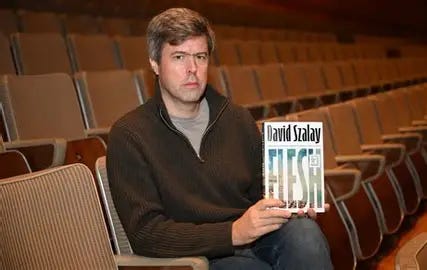
The story concerns a young Hungarian of no means or prospects joining the army, eventually getting to England, working as a bouncer in a strip-club , and, through charm and sex appeal rising through the ranks. Through a deft love affair, he eventually joins, or thinks he has joined the rich set, not as a chauffeur but as a member of the fast set, only to come the inevitable cropper.
This rags to riches and back again is a classic trope and if you believe, as I do, that there are only a limited number of plots in the world, then it is not surprising that Szalay, who is a spare, stylish writer, should have hit upon a story which one can see replicated in folk stories all over the world.
But there have been those who accuse him of borrowing from Stanley Kubrick’s wonderful film BARRY LYNDON, which is itself a dramatization of Thackeray’s novel of the name.

David Sexton, a book reviewer of long standing, says, ‘It’s not plagiarism,it’s completely legitimate to adapt something..He can’t deny this’.
There are indeed moments in FLESH where the allusions to the Kubrick film are so close as to be quotations. One thinks of a moment when Istvan, the oikish protagonist, trying to seem less likish than he actually is, is taken to the National Gallery by his protectress, and he says, ‘I like the use of the colour blue in that one’. In the Kubriock film, Barry Lyndon, speaking of the Adoration of the Magi by Lodovico Cardi, says, ‘I love the use of the colour blue by the artist’.
The story of FLESH and the story-line of BARRY LYNDON are indeed remarkably similar. And, as David Sexton says, there is nothing disgraceful about this.

Most novelists are distinctive for their style, their characterization, their realism or lack of it, and not simply for their story lines. I seldom review books these days, but I remember when I was more of a reviewer than I am now, pointing out that Ian McEwan’s early novel THE CEMENT GARDEN had a plot which was identical to that of Julian Gloag’s OUR MOTHER’S HOUSE. McEwan tearfully responded
