
HAMNET
Thoughts in the cinema about Mrs Shakespeare and others

It is a very beautiful film, and the star is the wood - the Forest of Arden, I suppose. The soughing of the green trees in the pure Warwickshire breeze, the great skies, the verdant purity… I had expected all this to be somehow reflected in the Shakespeare which is depicted in Chloe Zhao’s highly-acclaimed work - perhaps with depictions of Rosalind in the Forest of Arden in As You Like It. Instead, we have a witchy Ann Hathaway, whose own mother had been a wise woman, and who won’t have anything to do with church. Where is that coming from, I wonder?
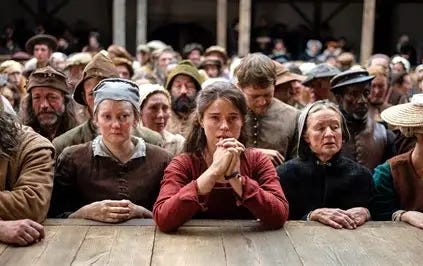
The real Ann Hathaway was much older than Shakespeare, but this one appears to be everlastingly young, brimming with sexuality, and so in love with herself that you can’t quite bear to watch. (Or I couldn’t). She is the perfect mother, of course, and the childbirths are all natural - the first one being in the woods, the twins coming along indoors. Unlike all her stuffy relatives, she is at ease in her beautiful body, and so in love with all the fungi, flowers, roots and herbs in the forest to want to go up to London and find out what it is which makes her apparently dim-witted hunk of a husband so interested in all this theatre malarkey.
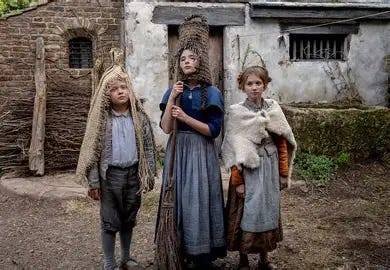
The only actor in the film I liked was the Susannah, played by Bodhi Rae Breathnach. At a fairly late stage of things, she reads to her younger sister from the Sonnets and for the first time, we hear Shakespeare’s poetic voice - really the only voice we care about . “And nothing gainst Time’s scythe can make defence…” For the first, and only time, in the film, I turned to gooseflesh. The rest - the screams and sweat as Mrs Shakespeare made love or gave birth, the death of poor little Hamnet, - all left me cold..
There is a Charles Addams cartoon - Uncle Fester Laughing in the Theatre -
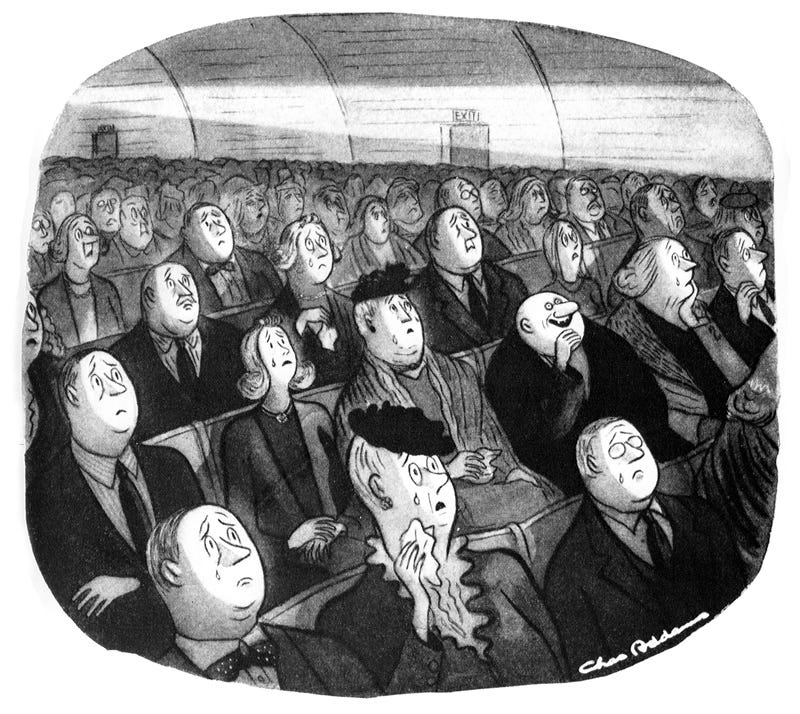
of a full cinema, and everyone in the audience weeping, except for the Addams weirdo, who is roaring with laughter. This wasn’t (quite) me and Ruth at the showing of HAMNET in our local flea-pit, but it was a bit shocking, how absolutely unmoved I was, as all around, one heard the snivelling and felt the bodies rocking with artificial grief.
I had not read the novel, nor am I likely to do so. This is not because Maggie O’Farrell is not a very good novelist, but because I am embarrassed by attempts to reconstruct the “real” Shakespeare, the man behind the plays, etc. It is so obvious that Shakespeare subsumed his ego, and is not to be found in the plays. Why look for the living among the fictitious?
The premiss of the novel is that Shakespeare, feeling grief for his little son Hamnet, who has died of plague, is so traumatized that he can never bring himself to mention plague, or Black Death in all his copious oeuvre. His wife, Agnes (sic) Hathaway is furious with him for being in London all the time, and she has never been to the smoke, and never seen a play. Somehow, out of all this grief and pain, he constructs his most famous play, HAMLET. She relents, comes to the Globe and is slowly won round to the magic of theatre.
But, but… but.. Ann Hathaway and Shakespeare in fact called their twins Hamnet and Judith because these were the names of their godparents, a Stratford upon Avon baker and his wife. There were several HAMLET plays before the death of Shakespeare’s son Hamnet - possibly one of them written in part by Shakespeare, so in real life, if one is allowed to mention it, Shakespeare was NOT inspired to write HAMLET because of his loss of HAMNET. As for his being so traumatized by the plague that he never brought himself to mention it in his works,,, there are innumerable mentions of plague and pestilence in his works, both dramatic and non dramatic. But the point is, not whether the O’Farrell version is even faintly plausible: it is that the whole oeuvre presents us with a refusal to write about himself. There is no point in looking in the plays for the inner or secret Shakespeare. He is simply not that sort of writer.
I found the beautiful actress playing Mrs Shakespeare, Jessie Buckley, really annoying; and Shakespeare himself, Paul Mescal, is not really drawn at all. He is a complete nonentity. Ruth (wife) told me that we had seen him in other things, and that he was a celebrated Handsome Devil, and that such actors and such plays were not meant for old men like me. I could just about believe that Mrs Shakespeare in real life was a sex goddess, like the actress in this film: but I can not believe that William Shakespeare had a really stupid face, as is, unfortunately, the case with Paul Mescal.
Fair enough. It’s a fiction. It does not matter. I do not know why Ann Hathaway is changed to Agnes, but I assume that O’Farrell has done this partly to emphasise that this is all an alternative reality and is not meant to be a representation of history. (In fact, as Jonathan Bate, Shakespeare scholar, has pointed out, there is evidence, quite recently discovered, that Ann Hathaway shared a house in London with her husband. (Bristol archivist Matthew Steggle found a letter, slipped into a book’s binding in Hereford, and addressed to “good Mrs Shakespeare” shows the dramatist and his wife to have been together, domestically, in London, in the first decade of the seventeenth century).
Of all great writers, Shakespeare appears absent from his work. We sometimes feel - and that way madnesss lies - that we can catch him, as we read the Sonnets, but even these are full of mystery. The relationship between the young man and the older man in the sequence makes us think - a bit - sometimes - of Falstaff and Hal, but only a bit, and if you tried to build a theory on the notion, you would be wrong.
Maybe, as you read the Sonnets, you feel they MUST reflect some situation in Shakespeare’s life. The obsession with the young man, who has a woman’s face with Nature’s own hand painted; the love for the Dark Lady; the overwhelming remorse and self-hatred in “Th’expense of spirt in a waste of shame”… You can not help wondering how Ann Hathaway felt as she read these poems, especially since she is the one named person in the sequence, and unmistakably comes into the sonnet sequence with the one poem in the batch which is NOT a sonnet - “I hate” from hate away she threw/And saved my life, saying, “not you”.
“Hate away” is clearly a pun on her name “Hathaway”. I more and more incline (in moments of madness) to Barbara Everett’s conceit that the whole sequence is addressed to Shakespeare’s wife. But I am not going to “go there”. When I am tempted to do, I think of my dear old friend and mentor, A.L.Rowse, who went a bit barmy, believing he had discovered he “real” Dark Lady of the Sonnets. When I went to say goodbye to him in hospital in Truro, a sad Cornish nurse said how “tragic” it was, to see this once great Cornishman raving. I told her, that this had not been brought on by his stroke; for the previous few years, he was always , as she would think, “raving” - ie sharing with anyone who would listen, his conviction that he had cracked Shakespeare’s secret.
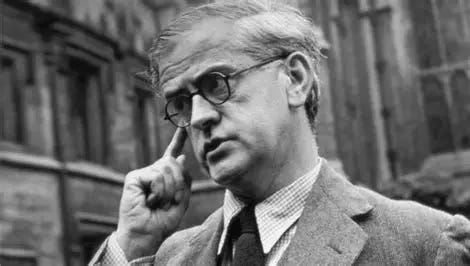
Chloe Zhao and Maggie O’Farrell show no interest whatsoever in the Sonnets, except when Susannah, his heir, recites from one of them. Nor do Chloe Z nor Maggie O’F ask what can have prompted Shakespeare to write poems of passion to a beautiful boy and a dark lady. The dolt in this film appears, when in London, to spend all his time in a dusty bedsit, just writing. No Mermaid Tavern, no rowdy friends like Ben Jonson, no relationship with the other players. The scenes where he is supposedly rehearsing the actors to play HAMLET are the most wooden thing you ever saw. Their Shakespeare is just an absurd dunce, who, in the last ten minutes of the film is revealed to have written a masterpiece. Another thing which annoyed me was that when Shakespeare appears as Hamlet’s Ghost (as he is traditionally supposed to have done) he is dressed, not - as the play makes clear that he is clad as a warrior king - “Such was the very armour he had on/When he th’ambitious Norway combated..” But this Hamlet’s Ghost was just wearing an old blanket covered in icing sugar. The young Hamlet - even in Zhao’s production, is urged to “cast thy nighted colour off” - ie his black mourning clothes, - but instead he is wearing a rather fetching pale blue doublet. Why???
Why was I annoyed? Why did I care? I suppose because behind the film, and the really ludicrous self-preening of Jessie Buckley, there was the sense that THEIR world, of witchy mumbo-jumbo, and women’s talk, and the countryside, was somehow more “real” than what blokes got up to when they went up to Lunnun. There is a sort of unspoken suggestion that Shakespeare’s real life, if he had only known it, would have been at home with the wife and kids. There is a sort of philistinism behind the shimmering green leaves and the over-confident Mum Knows Best of this version. And , as I say, it wilfully misses out the known facts - namely that Ann Hathaway - whatever the turmoil of Shakespeare’s mysterious emotional life - WAS with him in London, and she makes a star appearance in his only personal work of art - The Sonnets.
HA HA HA HA HA you have made me soooo happy. I hated this film so much I left somewhere after the second lot of possets. I had already hated the book, so I don't know why I wasted my time and money going, but I liked the previous film I saw by this director and thought she might have done something interesting with it. Not. The issue with the 'very stupid face' (HA HA HA HA HA again) was a large part of it for me too. Thank you for making me feel less alone.
Brilliant analysis and a joy to read, in great part because a profound understanding of Shakespeare, both the man and his genius, underlies it. I wonder whether the modish urge to « feminize » so many aspects of culture infected the making of this film.
Loved the story about A.L. Rowse