
Othello

The morning after I’d seen the Haymarket Theatre Othello some weeks ago, I woke up with the most terrible feeling of anguish. Something really awful has happened? A bad dream? No, it was something real? O, what was it? One of the children in an accident? Some awful financial news? But as my waking self took hold, I realized, it was the murder of Desdemona.
When I confided my dawning realization to my wife, who sat up beside me with her cup of tea, she said, ‘I don’t feel awful. I didn’t like any of them’. Point understood. I think it IS part of the strange experience of seeing, or reading Othello, that you do not have to LIKE the main characters. (Whereas, there comes a moment in Lear, for example, when this most unlikeable of monarchs has realized that he is loved by Cordelia, and you do absolutely love them BOTH. Then your heart cracks. Bleeds. And the funny thing is, call me weird, but I actually like the Macbeths though I can see they are beyond.
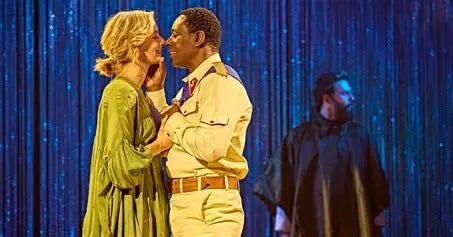
We had been to see Othello, a role which David Harewood has made his own over the years, with Toby Jones as Iago, and Caitlin Fitzgerald as Desdemona. Each of these actors was, to me, revelatory.
First, though, Desdemona. I have known several real life Desdemonas , and that is why, in my fantasy life as a Shakespearean director, I always know what I would say to the actor who was undertaking this, actually amazingly challenging, role. What do I mean by saying I have known Desdemonas? Far harder to act than to sing in Verdi’s admittedly wonderful version. They are the nicest types of women, Desdemonas. They are chatty, sympathetic, amusing, but above all, friendly. Because they are young women, their friendliness would be indistinguishable, in the eyes of a coarse person, from flirtatiousness, but it is quite, quite different. They would be (as recounted by Othello in the third scene of Othello Act I) perfect dinner companions, because they would genuinely be interested in what you had the say.
In the case of Othello and Desdemona, as it happens, his conversation, and his personality, are such that Desdemona does not merely enjoy his anecdotes, she falls in love with him, and - of course - as we understand at once from Othello’s diction, but he DOESN’T UNDERSTAND - with the music of his speech.
She loved me for the dangers I had pass’d,
And I lov’d her that she did pity them.
But Othello, who is such a good general, and such a good soldier, is actually emotionally speaking quite thick, so he can not distinguish between her friendly, trusting spirit, her love for him, which is actually something which she would only bestow in him, and the flirtatiousness (as it would appear in others but which in her case is NOT flirtatiousness).

David Harewood, incidentally, is NOT thick, but he acts this particular strand of Othello’s character so well. And, although we would all give an arm to have seen and heard Paul Robeson in the role, and although I have to admit that (sorry, I KNOW it is utterly incorrect to approve of Olivier’s version ) I think no one captures the Othello music better than Olivier, Harewood is pretty bloody marvellous. All the great speeches - even if you did not know them by heart, you would after hearing Harewood say them once. Best of all, in the production we saw, Farewell the neighing steed, and the shrill trump! (Even memory of Jeeves quietly murmuring, ‘Farewell the tranquil mind’ does not destroy the goose-fleshy appeal of this speech).
Funnily enough, the most Desdemona-ish woman I know did marry a soldier, and none of the Desdemonas I have known, thank God, have had the bad luck to marry a jealous partner.
After Othello’s wonderful speech, describing the dinners he had attended at the house of Venetian grandee Brabanzio, he says , ‘Here comes the lady. Let her witness it’.
Enter Caitlin Fitzgerald, former star of Masters of Sex (as I discover from Googling her. I was in the good position of not recognizing her or knowing ‘who she was’). My first sinking thought was - but she is much too old! Desdemona, who is spoken of by her father as a piece of property which has been filched by the Moor, is surely a teenager, or little more than this. But my doubts vanished after two sentences. Caitlin Fitzgerald was the best Desdemona I have ever seen, even though she is probably a woman of 40 plus. And she had an advantage. She is American. I realized, that this Desdemona-ish quality I am describing - of friendliness, and sexiness, but NOT flirtatiousness - is something which goes with perfect American manners.
She seemed like the best kind of diplomat’s or high-ranking officer’s wife, and when she accompanies Othello to Cyprus, you yearn for them to have some time to themselves, they both act being in love in an entirely un-squirm-making, touching manner. Iago, played by the truly masterly Toby Jones, of course, manages to undermine all that, partly because of his own poisonous inability to see charm, simple niceness, when it is obviously there, and to interpret Desdemona’s behaviour as lust.
Jones has a rather amiable face, but he is such a good actor that he managed to recreate Iago’s ‘motiveless malignity’ and make it totally plausible, with that chippy, sneery, self-pitying expression which chills the marrow. Shakespeare saw this as an essentially unpleasant quality. Today, his class-chippiness, which is the beginning of the trouble, though far from being the end of it, would be seen as sympathetic.

So, that was why I woke up the next morning feeling so awful. Because Iago’s ugly vision, not only of his noble senior officer, but of the world, has demeaned us, but because the violence which must be in any good soldier’s make-up, has been perverted and turned to killing a blameless, nice woman. Goodness, they acted the scene of the murder so completely brilliantly! And the scene worked so well because Iago’s wife, Desdemona’s maid was so superbly played by Vinette Robinson.

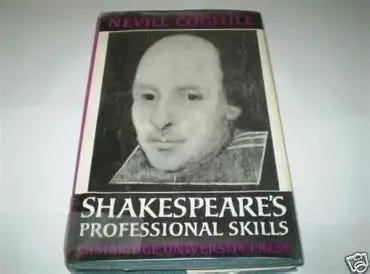
If you are one of those benighted people who doubts that Shakespeare wrote his plays, I beg you to read Nevill Coghill’s Shakespeare’s Professional Skills, and the chapter entitled “Revision after Performance”.
Shakespeare nerds will remember that
