
Small Prophets
Consolations of gentleness

Pierce Quigley was not a name I knew, though I realize I must, in fact, have seen him on stage - bearded, and slightly Gandalf-ish. I see that he has played Falstaff in that very much under-estimated comedy The Merry Wives of Windsor. Would he have the necessary oomph to do so, I wonder ?
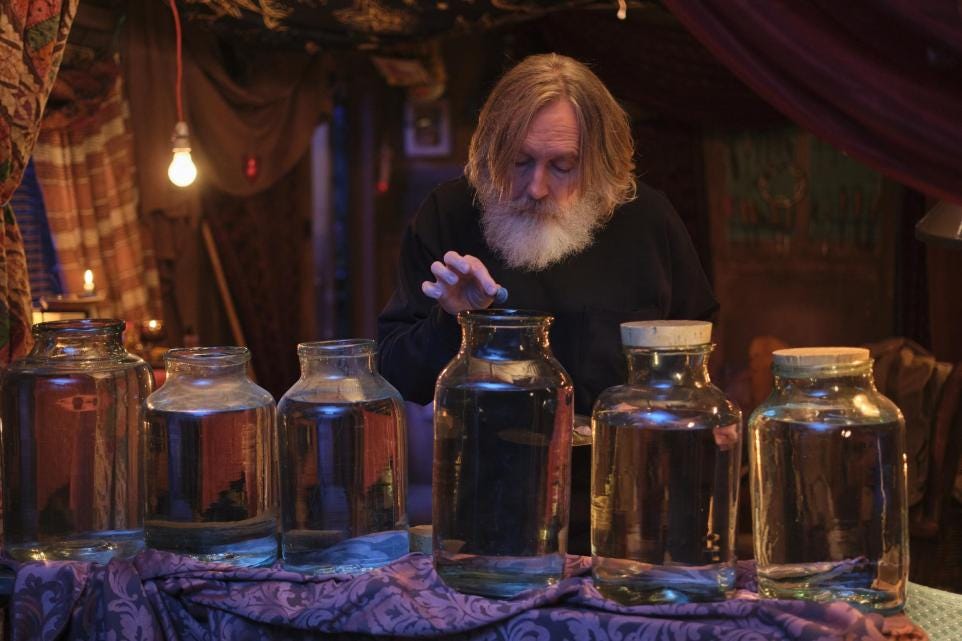
But I only wonder that because he is such a good actor in this new TV series, Small Prophets, and I therefore identify him with the character he plays : Michael Sleep, a hippyish type, working in a gigantic DIY store, in some dump of a provincial town, and getting a kick out of playing very mild teases on the customers, and very very mildly flirting with a much younger female colleague
.
Michael is a man with a Dad, and a man with a shed. Seven years ago, his girlfriend Clea left - quite suddenly - just before Christmas. He had done up the sitting-room in full festive fashion, and now, Havisham-like, he keeps it, hoping for her return - with all the lights, the tree, the tinsel.
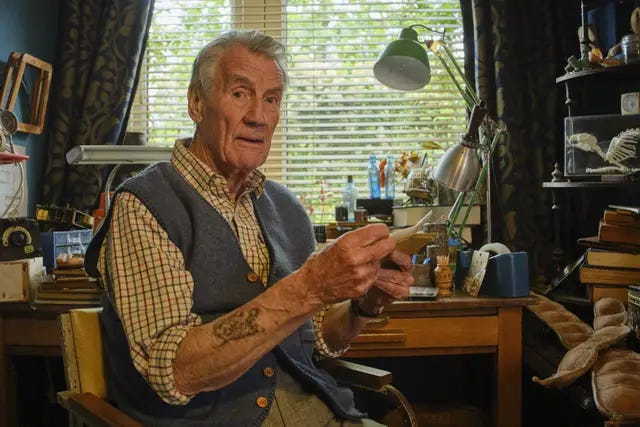
The Dad is in a care home and is played with such touching skill by Michael Palin. Years ago, when Dad was doing National Service in Egypt, he learnt how to create or summon up homunculi in water-jars. These funny little creatures will, when sufficiently mature, be able to foretell the future. If only Michael can make some homunculi, and cherish them, in the secrecy of his shed, he might be able to get them to tell him the truth about his missing girlfriend.
It sounds such a very unlikely idea for a successful TV sit-com. How could it NOT be simply silly - bloody daft, in fact? Yet, such is the skill of the script, written by Mackenzie Crook, [who created Detectorists, and who in this one is Michael Sleep’s officious boss in the DIY place] , you buy it all.
At first, when Michael Palin starts to tell his son about the homunculi, you think it is a sign of senility. Then, Michael’s heartbreak, his yearning to be reunited with Clea, makes him think it is worth a try, however crazy it seems. You wonder - surely Mackenzie Crook isn’t going to take the risk of making the homunculi actually appear? Surely it would work much better if the two men TALK ABOUT the funny little creatures, during Michael’s visits to the care home, and we, the viewers, never get to see them? But, no, there they are…
And I suppose that is the secret of why the series works, apart from the fact that the acting is so good ; it is the element of heartbreak. Michael is such a gentle man, and his father , tiresome old git as he might be, is also loveable, and good. And we so want to know what happened to the girlfriend.
I’d been having lonely evenings for the last few weeks because my wife, with whom I often watch telly, became addicted - years after the rest of the TV-viewing public - to Breaking Bad.
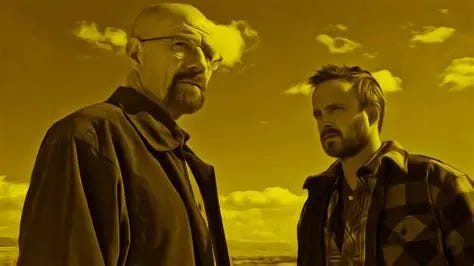
Only about ten minutes of this endless series of programmes, about a science teacher in a High School who learns how to make highly saleable drugs - was enough to tell me - it’s not for me. Now and again, I would go into the room where Ruth sat , glued, to bring her some tea, or to bid her goodnight, and the grisliest screen violence was being perpetrated on or sometimes by the, surely very VERY unamiable characters. And the series ran and ran, for dozens of episodes.
To my huge relief, Ruth AT LAST finished watching this, and called me, wondering if I’d like to try this new series about a man with a beard, growing homunculi in his garden shed. I wasn’t very hopeful, when the invitation was put in that way. But it is a marvellous programme. I was going to say it was escapist, but it isn’t. The weird thing about semi-porn violence is that it is escapist in the sense of being not realistic. It is horrible enough to be disturbing, but it is not real on any level. Thank goodness, few of us confront scenes of violence very often , and when we do, it’s not like the staged violence of films. Michael Sleep’s gentle grief for a woman he loved, and the tedium of his job, and the worry and exasperation, and love, which he feels for a slightly confused parent in a care home, and his nosy, comical neighbours are far more realistic.
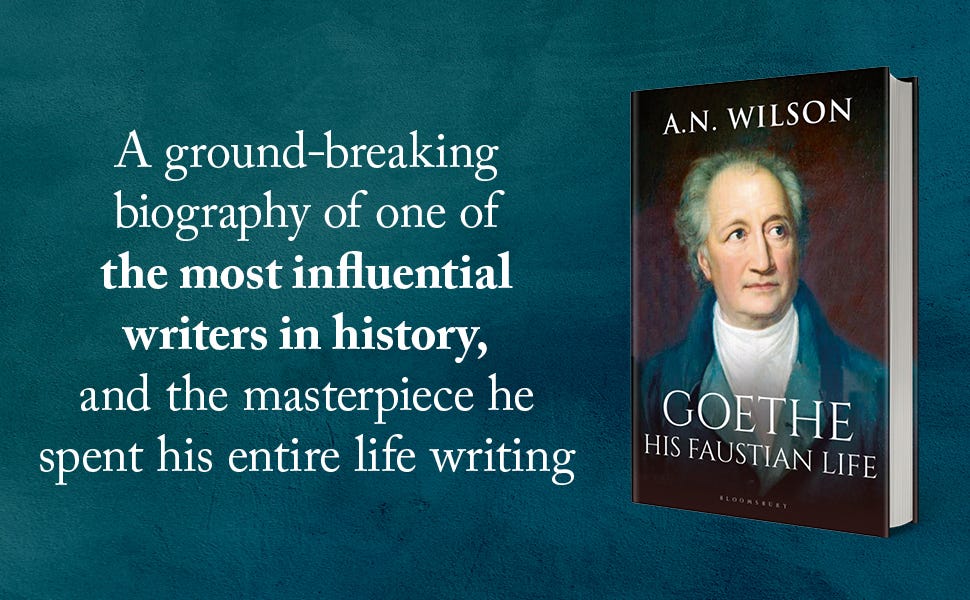
In the Second Part of Goethe’s Faust, there is an homunculus, who, mysteriously, can see into Faust’s brain, and who , even more mysteriously, summons up for us the Classical Walpurgisnacht. I do know readers who say they can stomach everything Goethe wrote, but not the homunculus. It’s the best thing Goethe ever wrote, in my view - especially the scenes between Helen of Troy and Faust. Their baby, Euphorion, is a sort of Lord Byron-figure. I wonder if it influenced Mackenzie Crook in any way as he was writing Small Prophets?
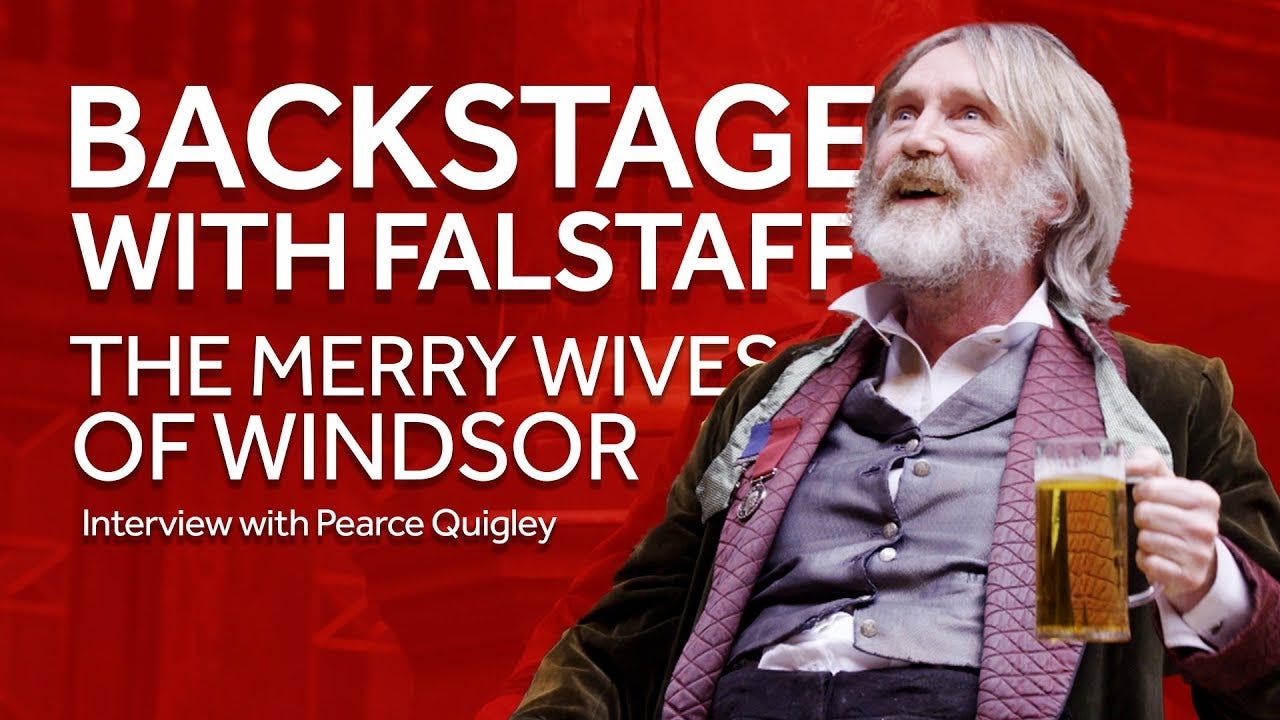
I also wonder if one can get Pearce Quigley’s Falstaff on YouTube? Or, even, whether this new TV series will be such a success that he can repeat the performance on stage? In my view/guess, it is the most demanding of all Shakespearean roles, even more demanding than Lear.
Everything you write makes me feel less alone. I watched a few episodes of Breaking Bad because everyone else was and when we got to the blood dripping through a ceiling from a murdered corpse I could endure no more. I don't need such concepts in my head. I also adored Small Prophets. The very unlikeliness of it being commissioned delighted me and so many satisfying details. The ghastly manager stroking his awful pony tail. The dead shiny desert of the neighbours' kitchen. The charming denoument with the cycling teenager. The satisfying ending. Perhaps we share taste, Mr Wilson, because we went to the same school (not at the same time). Laudare, benedicere, praedicare.
It’s so good . Its innocence is so heartening , the hope and the weirdness and the funniness all combine to make something outstanding. McKenzie Crook’s pony tail alone made me laugh and Michael Palin adorable . I agree - brilliant that we see the homunculi